
The Vikram Moon Lander, named after the father of India's space mission Vikram Sarabhai on his birth centenary year, is scheduled to touch the lunar surface near its south pole on September 7 about 1.55 am.

There will be two more orbit manoeuvres to make the spacecraft enter into its final orbit passing over the lunar poles at a distance of about 100 km from the Moon's surface.

All spacecraft parameters are normal, the Bengaluru headquartered space agency said after the maneuver.

Aditya-L1 is the first Indian space-based observatory that will study the Sun from a halo orbit around the first Sun-Earth Lagrangian point (L1), which is located roughly 1.5 million km from the Earth.

"Since its injection into Earth's orbit yesterday, it has been functioning smoothly on the orbit. We are planning to perform orbit raising manoeuvres in the early hours of of Thursday," an Indian Space Research Organisation spokesman told PTI over phone.

Countdown began on Thursday for the launch of the latest navigation satellite that will make India on par with the GPS of the US.

Vikram (with rover 'Pragyan' housed inside) is expected to touch down on the lunar surface on September 7, between 1.30 am and 2.30 am.


The New York Times, The Washington Post, The BBC and The Guardian, among many other leading foreign media outlets, all carried stories on Chandrayaan-2, India's landmark moon mission.

Other than the Cartosat-2 series satellite, the PSLV is carrying 29 nano satellites from 14 countries - Austria, Belgium, Chile, Czech Republic, Finland, France, Germany, Italy, Japan, Latvia, Lithuania, Slovakia, the United Kingdom and the United States of America besides a nano satellite from India.
The Chandrayaan-2 spacecraft is expected to reach the moon's orbit on August 20 and land on lunar surface on September 7.
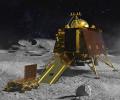
ISRO chairman K Sivan said the proposed soft-landing was going to be a 'terrifying' moment.

Amphibious drones for maritime inspection... devices that extract pure oxygen from water for patients in need... self-balancing electric bikes...

Having reached the Red Planet, ISRO can now focus on getting humans in space and secure the resources to do it

The ISRO team worked tirelessly to make the Mars mission a success

On Monday, ISRO scientists will run a test of the Mars orbiter satellite's main engine and make a small course correction. This is crucial because the engine has been idle for nearly 10 months. T E Narasimhan reports
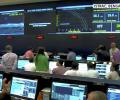
'When you look at it from the point of view of science, Chandrayaan 2 is a big success.'

The stage is set for the launch of India's satellite IRNSS-1D on Saturday from Sriharikota onboard workhorse PSLV-C27 that would pave the way for the country's own navigation system on par with the GPS of United States.

'The unique achievements have been made by engineers from small towns who have had a non elite upbringing and who have grown with the programme,' says R Aravamudan, one of the pioneers of the Indian space programme.
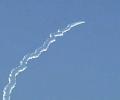
India on Monday successfully launched the first technology demonstrator of indigenously made Reusable Launch Vehicle, capable of launching satellites into orbit around earth and then re-enter the atmosphere, from Sriharikota in Andhra Pradesh.

ISRO's expedition to Mars is yet another breathtaking adventure for an organisation created by Dr Vikram Sarabhai and carefully nurtured by scientists like A P J Abdul Kalam and R Aravamudan.

Some time before December 31, 2017, Bengaluru based Team Indus aims to land a vehicle on the moon.
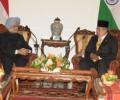
The two countries have decided to expedite trade related issues and signed six pacts to take forward their strategic partnership. Rediff.com's Sheela Bhatt, who is travelling with the prime minister on his visit to Indonesia, reports from Jakarta.
 © 2026 Rediff.com - Advertise with us - Disclaimer - Privacy Policy - Sitemap - Feedback - About us - Terms of use - Grievances